Port of Jumanah — First Look & Gameplay Impressions

Updated: Sep 27
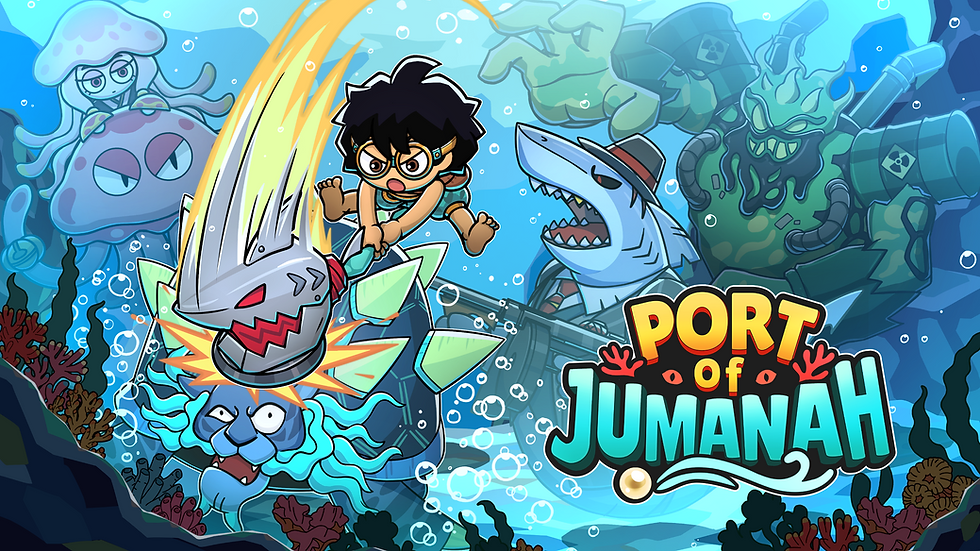
Pearl diving sounds like a fairly peaceful job. Have a swim, find something shiny, and head home.
Port of Jumanah appears to have missed the “peaceful” part.
After initially checking out the game from its trailers and gameplay footage, I finally got the chance to jump in myself and spend around an hour exploring Jumanah.
And honestly? That hour surprised me.
I expected an action-heavy roguelite with an interesting Arabian-inspired setting. What I found was a game with satisfying combat, some ridiculous build possibilities, plenty of character and considerably more going on outside the fighting than I expected.
These are still first impressions rather than a full review — an hour isn't enough time to judge everything the game has to offer — but I've now played enough to have a much better idea of what Port of Jumanah is actually trying to do.
And, more importantly, whether I want to play more of it.
I definitely do.
Pearl diving with considerably more monsters
You play as Mansour, a pearl diver whose occupation apparently includes dealing with monsters, helping the locals and getting into considerably more trouble than the job description probably mentioned.
The basic structure sees you heading out into the world, fighting enemies, completing objectives, collecting resources and becoming increasingly powerful along the way.
There's an obvious roguelite influence here, and Hades was the comparison that immediately came to mind while I was playing. Someone in my stream chat actually made the same comparison.
But after spending some time with it, I don't think simply calling this “Arabian Hades” really does Port of Jumanah justice.
There are similarities, particularly in the fast combat and the way different upgrades can transform a run, but Port of Jumanah quickly begins establishing an identity of its own.
Sword, dodge, roll… and a Harpoon Gun
The combat was one of my biggest questions going into the game.
Having now played it, I can answer that one.
It feels good.
Mansour starts with a sword for close-quarters combat alongside a Harpoon Gun for ranged attacks.
The swordplay is responsive and easy to understand. Attack, reposition, roll and dodge before jumping back into the fight. It didn't take particularly long before I found myself comfortably moving between enemies and avoiding attacks.
The harpoon gun was equally fun. It fired a piercing shot and quickly became useful whenever I wanted to create some distance and attack enemies from range.
Having access to both meant I wasn't simply hammering the same attack repeatedly.
I could get aggressive with the sword, roll or dodge out of danger and then switch to the Harpoon Gun when I needed some breathing room.
It's accessible enough that I quickly understood what I was doing, but there's more happening underneath once the game's upgrades and blessings start entering the equation.
And that's where things got slightly ridiculous.
I may have overdone the buffs
As you explore, you'll encounter different opportunities to strengthen Mansour.
During my first session I met Sulhu Fa, a hermit turtle who offers blessings known as Shell Boosters.
These allow you to choose between different bonuses, with one of the options I encountered — Advance Ballistics I — providing a 10% increase to gadget damage.
Buff machines found during stages provide even more opportunities to power yourself up.
And importantly, those buffs can stack.
During one stage I encountered two separate buff machines.
Naturally, I decided moderation was completely unnecessary.
I grabbed upgrades from both, and by the time I'd finished stacking everything together, I had nine different buffs active.
At this point I was preparing for a stage boss and expected a decent fight.
It lasted about 30 seconds.
All those upgrades working together turned Mansour into an absolute monster, and the poor boss was essentially deleted before it had much opportunity to object.
It was hilarious, but it also showed me why the upgrade system could become one of the most interesting parts of the game.
Rather than every run simply being about improving your reactions, there's an element of experimenting with what you find, building combinations and seeing how ridiculous your character can become.
I've only scratched the surface after an hour, so I don't yet know how deep that system eventually gets or how well the difficulty keeps up with powerful builds.
But I certainly want to find out.

There's actually quite a lot to do
Another pleasant surprise was discovering that Port of Jumanah isn't simply a sequence of combat rooms.
There's considerably more interaction with the world than I expected.
You'll meet NPCs, pick up main objectives and take on smaller side missions.
One of those characters is Abdullah, who asks you to collect five fish by heading back out and defeating fish-like enemies.
It's a relatively simple objective, but completing it leads to something more interesting: Abdullah can join your crew.
There's also the larger goal of upgrading and fixing up your boat, allowing you to progress further and eventually reach different areas of the world.
That combination of exploration, characters, quests and progression gives the game some light RPG flavour and makes Port of Jumanah feel more like somewhere you're adventuring through rather than simply a backdrop for another run.
That's probably the biggest difference I noticed between this and something like Hades.
The combat scratches a similar itch, but Port of Jumanah seems interested in giving you more reasons to interact with its world between all the rolling, dodging and monster slapping.
Your crew matters too.
Recruiting Abdullah also introduced me to another part of the progression system: Ship Crew.
Once Abdullah joined, I could assign him to my boat. Doing so activates his Organised Hold perk, which gives gathered resource materials a 50% chance of being doubled.
That's a meaningful reward for completing what initially looked like a fairly straightforward side quest.
Instead of Abdullah simply becoming another character standing around after I'd helped him, recruiting and assigning him could directly affect what I brought home from future expeditions.
I also encountered Sultan, another potential crewmate, although his requirements were slightly more demanding.
Sultan challenged me to defeat 100 enemies before he would join the crew.
I didn't complete that during my first hour, so Sultan will have to wait for another expedition.
But even encountering these two characters has me interested in seeing how large the crew can eventually become, what challenges other potential recruits have and what bonuses they bring aboard.
You're not only improving Mansour during individual stages. Completing objectives out in the world can potentially unlock permanent crew options that influence future expeditions.
That's another layer of progression I wasn't expecting when I started playing.

A world with its own charm
The Arabian-inspired setting also gives Port of Jumanah plenty of personality.
Its visuals have a colourful, almost cartoon-like quality to them, and after actually playing the game rather than simply watching footage, I've grown to like that style even more.
It isn't chasing realism, nor does it need to.
There's a charm to the environments and characters that fits the slightly larger-than-life adventure happening around you.
The soundtrack deserves some credit too. Music can easily disappear into the background when you're concentrating on combat, but what I heard during my first hour complemented the setting nicely.
Taken together, the visuals, music, and setting give Port of Jumanah an identity beyond its obvious roguelite influences.
First impressions after one hour
An hour isn't enough to see everything Port of Jumanah has to offer, but it was enough to leave me with a strong first impression.
Most importantly, the combat doesn't just look good—it feels good too.
The controls were responsive, switching between close-range sword attacks, and the harpoon gun felt natural, and once the different buffs started stacking together,
I found myself experimenting with the systems rather than simply attacking whatever was in front of me.
What surprised me most, though, was how much was happening outside the combat.
The mixture of swordplay, ranged attacks, dodging, stacking buffs, blessings, recruiting crewmates, completing quests, gathering resources, and exploring the world made my first hour fly by.
And perhaps the best compliment I can give Port of Jumanah at this stage is a very simple one:
I finished my stream, wanting to carry on playing.
What I still want to discover
There are still plenty of questions an hour of gameplay can't answer.
I want to see how varied the later areas become, how deep the crew system goes, what other passive bonuses can be unlocked, how the wider progression develops and whether increasingly powerful buff combinations remain balanced against tougher enemies and bosses.
I'm also curious about characters such as Sultan. If recruiting one crewmate can already affect resource gathering, what other bonuses are waiting as the crew expands?
Those are questions for another session.
At just over £10, my first hour has already shown me considerably more variety than I expected at that price point. I'm not ready to make a judgement about the entire game based on a single session, but what I've played so far has left a very positive impression.
For now, Port of Jumanah has gone from a game that looked interesting to one I'm genuinely looking forward to returning to.
I went in expecting pearl diving.
An hour later I'd stacked nine buffs, obliterated a boss, and somehow agreed to hunt mutant fish for somebody.
Yeah, I think I'll be going back.
Watch our gameplay
My first hour with Port of Jumanah was played live, so if you'd rather see the game in action instead of simply taking my word for it, you can watch the gameplay from the stream.
And if you just want to see what happens when you encounter two buff machines, make questionable decisions, and walk into a boss fight with nine buffs active, I've clipped that too.
Full gameplay: [https://www.youtube.com/live/GSwCfCU6nKM]
9 Buff Boss Fight: [https://www.youtube.com/shorts/J5hzsJgVVfc]
Where can you play Port of Jumanah?
Port of Jumanah is available on PC through Steam and the Epic Games Store, as well as PlayStation 5.
The game is developed and published by Red Dunes Games and launched on 7 September 2026.
At the time of writing, the game also holds a Very Positive user rating on Steam, based on 144 user reviews.
A free demo is available through Steam if you'd like to try it before committing to the full game.
Game: Port of Jumanah
Developer: Red Dunes Games
Publisher: Red Dunes Games
Release date: 7 September 2026
Platforms: PC (Steam/Epic Games Store), PlayStation 5
Steam reception: Very Positive — 144 user reviews (at time of writing)
Played for: Approximately 1 hour
Platform played: PC – Steam
Coverage: Hands-On First Impressions
Review score: None — we'd rather explain what worked, what didn't and what we're still exploring.
Disclosure: Port of Jumanah was provided for coverage through PRHound. The opinions in this article are based on our own hands-on gameplay experience.


Comments